This past December, my aunt sent out a request to the family to send my 4-year-old cousin some mail because he was sad none of the packages or cards arriving were for him. I decided to write him a fairy tale, but being a practical person I also included a coloring page because I know which side of my bread is buttered. The coloring page was definitely the most well-received aspect of that Christmas card. I wasn’t upset, though. It was a chance for me to practice a different form of writing, and to write for an audience.
I’ve been rather fascinated with red-winged blackbirds for a couple years now and have been wanting to write about them, so they are the subject of my short story. Maybe they weren’t the best or most interesting choice for a 4-year-old boy, but I went ahead with the topic anyway. I spent a lot more time on this story than I normally would, going through three or four hand-written drafts before turning to the computer. Part of the reason for this was to give me more time to think about the content and format.
Initially, I had a much more detailed plot planned for this story. However, I realized very quickly that if I stuck to my original plan I would be writing a complicated children’s book and not a simple short story. Given the limited attention span of 4-year-olds, and the fact that I wanted to get him that card before Christmas (I failed, but it was still December), I drastically reduced the scope of the story to one specific aspect of red-winged blackbirds that he was likely to experience on his own (their song). I also worked to strike a balance between superfluous description and interesting detail. I figured a small child would relate more to the significance of a name and simple descriptions than complex explanations of landscapes.
I was also more careful than normal when choosing my words, limiting my use of three- or four- syllable words. When I did use one, I asked myself if it was necessary, or if there were other, simpler words I could use instead. By my count, there are 17 instances of three- or four-syllable words in the story below, and many of them end in -ed, -ing, or -ly. Two of them are a proper noun (America). Two words that I specifically decided to keep were “horizon” and “investigate”. While I wanted the story to be accessible to a 4-year-old’s vocabulary, I didn’t want to treat him like he was stupid, and the educator in me balked at the idea of not introducing him to a couple more difficult words that he may or may not have heard before. I was also fairly certain that the mind-numbing children’s programming my cousin watches would have used the word “investigate” at some point.
The final result isn’t my favorite story, but I’m pleased with the way my experiment turned out. It was a good way of challenging myself to do something I hadn’t attempted before. If I want to continue practicing writing simple fairy tales, I may try to continue with this subject.
How the Red-Winged Blackbird Got His Song
Long ago, one of the first red-winged blackbirds to exist flew into a land that would one day be the state of Iowa. His name was Sunset, or Sun for short, because the bright red bands on his wings were the same color as the horizon when the sun set in the evenings. He was very lonely because there weren’t many red-winged blackbirds yet, and they were scattered across all of North America.
The red-winged blackbirds were so new they hadn’t been able to decide how they would behave. This included questions like: How would they eat? How would they find mates? What would their nests look like? How would they defend themselves? They didn’t even have a song. Since there were so few of them, and they were so far apart, none of this had been decided yet.
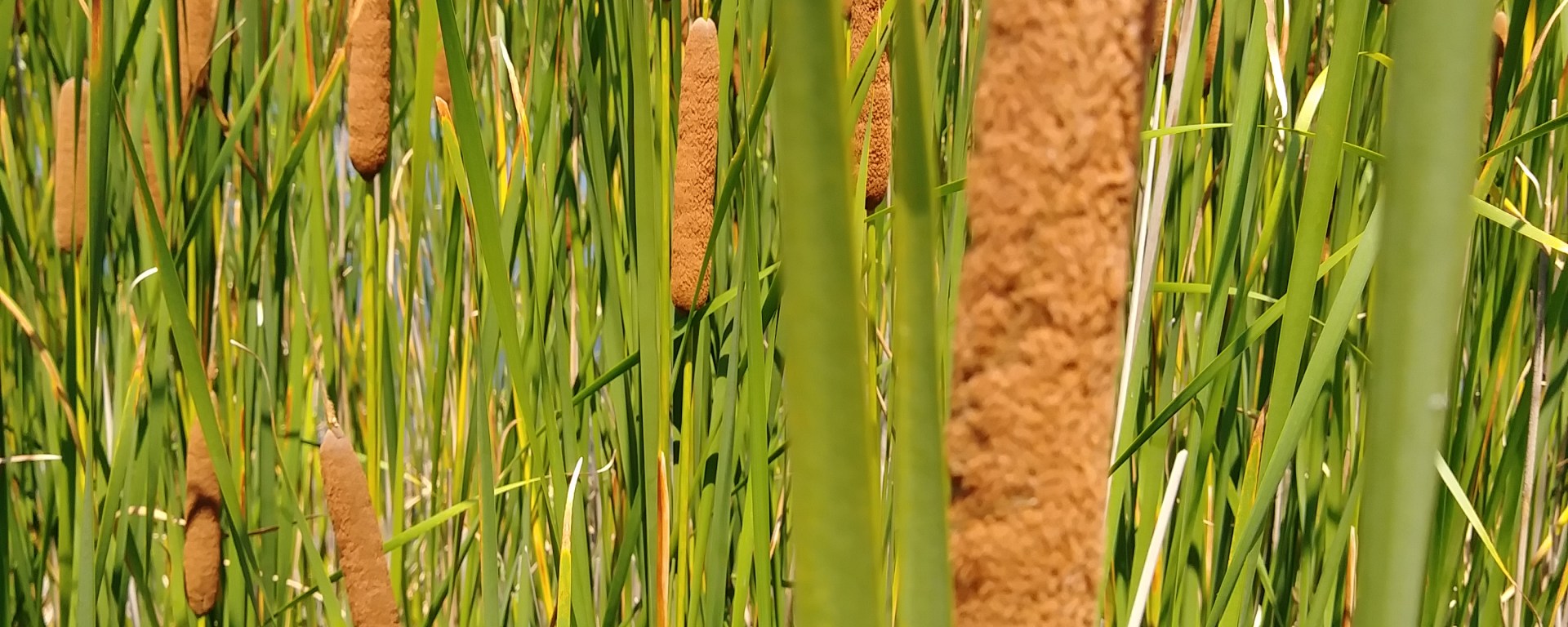
As Sun was flying, he saw a wetland that looked like a nice place to rest. He flew down and perched on top of a cattail, which sagged gently under his weight. Sun thought the wetland, with which had tall grass and slow-flowing water as far as he could see, would be a great place to make a home. The only thing wrong was that he was still lonely. He wished some other red-winged blackbirds would come and live there with him.
Sun decided he would try to sing to see if any other red-winged blackbirds were nearby, but he didn’t know if he could sing. Deciding he had nothing to lose by trying, he puffed out his chest and wings so his red bands showed and gave a great big TWEET. It didn’t sound very musical, but after practicing for a few minutes he came up with a song that sounded something like “conk-a-LEEEE”. He liked this sound, and he repeated it over and over proudly.
Sun sang for hours. Some of the other animals in the wetland paused to watch him curiously before continuing on their way. None stopped to talk to him. He sang as the sun sank in the sky and the horizon turned as red as the bands on his wings. He was about to give up and go to bed when another red-winged blackbird finally flew up and perched on a nearby cattail.
This bird’s name was Night because his feathers were so black. He had heard Sun’s song and, never having heard anything like it before, had come to investigate. Both birds were thrilled to find a friend. Night learned Sun’s song quickly, and they spent the whole next day singing it all over the wetland. By sunset they had found two more red-winged blackbirds. Each day more and more heard their song and came to the wetland until there were over 100 of them.
This was the most red-winged blackbirds that had ever been together in one place. It was enough for them to start deciding how they would behave. They all gathered in the biggest tree in the wetland and started the long process, which could take weeks or even months. The very first thing they did was make Sun’s song their official birdsong. His song had brought them together, and they were all grateful. This is why you can still hear the red-winged blackbirds calling to each other on spring and summer days in Iowa and all over North America.
 Staring Out A Window